
 Navigation -


<<< Back to Index


Chester Cathedral
<<< Back to Tours
12 Abbey Square
Chester
CH1 2HU
www.chestercathedral.com
office@chestercathedral.com
01244 324 756
 https://www.x.com/ChesterCath
 http://www.facebook.com/pages/Chester-United-Kingdom/Chester-Cathedral/104418419598922
45 Minute Organ Recital Every Thursday 1:10pm
<<< Back to Tours
12 Abbey Square
Chester
CH1 2HU
www.chestercathedral.com
office@chestercathedral.com
01244 324 756
https://www.x.com/ChesterCath
http://www.facebook.com/pages/Chester-United-Kingdom/Chester-Cathedral/104418419598922
45 Minute Organ Recital Every Thursday 1:10pm
https://www.x.com/ChesterCath
http://www.facebook.com/pages/Chester-United-Kingdom/Chester-Cathedral/104418419598922
45 Minute Organ Recital Every Thursday 1:10pm
https://projectionartgallery.com
Luxmuralis at Chester Cathedral Nave

News
https://www.facebook.com/chestercathedral
Easter Good Friday 2026
Chester Cathedral
Good Friday is the day when Christians remember the crucifixion and death of Jesus Christ.
Traditionally between the hours of 12pm and 3pm.
Today at 12noon the choir will be sining The Crucifixion by John Stainer (this will be one of the musical highlights of Holy Week).
Followed by a reflective hour of poetry, silence, and hymns at 1pm.
The final hour is the Liturgy of Good Friday, which includes hymns and a reading of the Passion Narrative.
People can come and go during the Three Hours if they don’t want to stay for the whole time.
At 8pm all are welcome to join us for Tenebrae (meaning 'The Darkness') sung by the Cathedral Choir.
This service is characterised by a passage of light to darkness through the extinguishing of candles.
Through its Scripture and song, Tenebrae offers a prolonged meditation and commemoration of Christ’s suffering: a darker prelude to the light of Easter.
Three Hours at the Cross and Tenebrae will also be available to watch on our YouTube channel.
https://www.facebook.com/chestercathedral
Easter Good Friday 2026
Chester Cathedral
Good Friday is the day when Christians remember the crucifixion and death of Jesus Christ.
Traditionally between the hours of 12pm and 3pm.
Today at 12noon the choir will be sining The Crucifixion by John Stainer (this will be one of the musical highlights of Holy Week).
Followed by a reflective hour of poetry, silence, and hymns at 1pm.
The final hour is the Liturgy of Good Friday, which includes hymns and a reading of the Passion Narrative.
People can come and go during the Three Hours if they don’t want to stay for the whole time.
At 8pm all are welcome to join us for Tenebrae (meaning 'The Darkness') sung by the Cathedral Choir.
This service is characterised by a passage of light to darkness through the extinguishing of candles.
Through its Scripture and song, Tenebrae offers a prolonged meditation and commemoration of Christ’s suffering: a darker prelude to the light of Easter.
Three Hours at the Cross and Tenebrae will also be available to watch on our YouTube channel.

Chester Cathedral Advent Procession
TBA 6pm Chester Cathedral
The service moves from darkness to light as we mark the beginning of the season of Advent.
Live stream
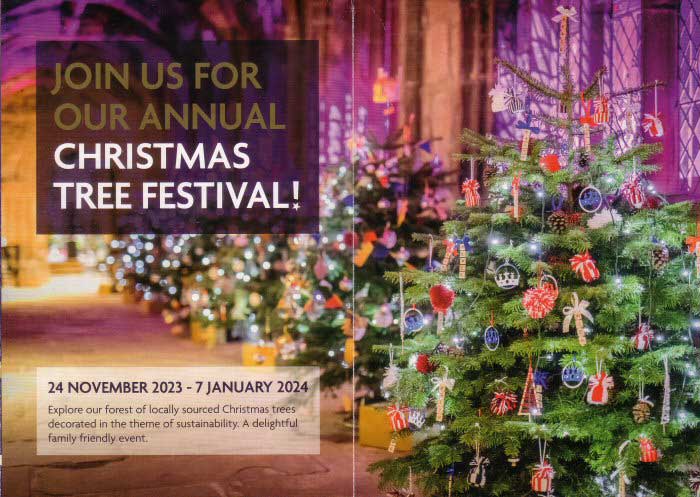
Christmas Crackers
https://chestercathedral.com/events/event/22824
16th December 2024
7:30pm
Chester Music Society (CMS Choir) Christmas Cracker Annual Concert in Chester Cathedral.
Chester Music Society Choir perform popular Christmas carols.
Set inside the wonderful Chester Cathedral at the centre of Chester.


16th December 2024
7:30pm
Chester Music Society (CMS Choir) Christmas Cracker Annual Concert in Chester Cathedral.
Chester Music Society Choir perform popular Christmas carols.
Set inside the wonderful Chester Cathedral at the centre of Chester.


Opening Hours
Monday–Saturday
Cathedral 9am–5pm Refectory 9:30am–4:30pm
Sunday
Cathedral 1pm–4pm Refectory 12Noon-4pm
Bank Holidays
Monday–Saturday
Cathedral 9am–5pm Refectory 9:30am–4:30pm
Sunday
Cathedral 1pm–4pm Refectory 12Noon-4pm
Bank Holidays
Coach parties use the drop off point on St Nicolas Street Ring Road next to the Guild Hall and park in the Little Roodee Car Park.
Admission
The Cathedral is open to visitors at 10am
Entry is free (£3 Donation if you wish)
The Cathedral is open to visitors at 10am
Entry is free (£3 Donation if you wish)
Chester Cathedral Admission
Click here for more information

How to find the Cathedral
Chester Cathedral is located near the very centre of historic Chester within the walls opposite the Town Hall. The high central tower is not visible for all parts of the city. Find the Eastgate Clock and walk towards the cross on Eastgate Street and turn North up St Werburgh Street opposite the Grosvenor Shopping Centre.
Friends of Chester Cathedral
Friends of Chester Cathedral
Join the Friends by enrolling at the Admission Desk or click here
Groups (10 or more) £4 pp (adult) - £2 (children under 16)
GROUPS ARE REQUESTED TO BOOK AHEAD AND SERVICE TIMES SHOULD BE AVOIDED.
To book a Group Visit please telephone Cathedral Visits on 01244 500 958
Shop
Cathedral Shop
Friends of Chester Cathedral
Friends of Chester Cathedral
Join the Friends by enrolling at the Admission Desk or click here
Groups (10 or more) £4 pp (adult) - £2 (children under 16)
GROUPS ARE REQUESTED TO BOOK AHEAD AND SERVICE TIMES SHOULD BE AVOIDED.
To book a Group Visit please telephone Cathedral Visits on 01244 500 958
Shop
Cathedral Shop
Friends of Chester Cathedral
Join the Friends by enrolling at the Admission Desk or click here
Groups (10 or more) £4 pp (adult) - £2 (children under 16)
GROUPS ARE REQUESTED TO BOOK AHEAD AND SERVICE TIMES SHOULD BE AVOIDED.
To book a Group Visit please telephone Cathedral Visits on 01244 500 958
Shop
Cathedral Shop
Chester Cathedral Shop
Click here for more information

12 Abbey Square
Chester
Cheshire
CH1 2HU
Contact Mrs Julie Wheeler
01244 699 049
shop@chestercathedral.com
http://www.chestercathedral.com/chester-cathedral-shop.htm
2011 Opening times
9:30am to 5pm Monday to Saturday
11am to 4.00pm Sunday
Refectory
Refectory
Falconry
Falconry has been discontinued over Covid.
Falconry
Falconry has been discontinued over Covid.
Special Events
Dean's Field
Retreat House
Click here for more information on
Retreat House
Guided Tours
Cathedral at Height Tour
Click here for more information
Video Guided Tour
Click here to watch the video
Dean's Field
Retreat House
Click here for more information on
Retreat House
Guided Tours
Cathedral at Height Tour
Click here for more information
Video Guided Tour
Click here to watch the video
Click here for more information on
Retreat House
Guided Tours
Cathedral at Height Tour
Click here for more information
Video Guided Tour
Click here to watch the video
Click here for more information
Video Guided Tour
Click here to watch the video
Chester Cathedral Guide Brochure
Estimated time to look around 1 Hour.
The Floor surface is flat with small steps to the various areas. There is a wheelchair ramp at the entrance.

The Patron Saint of Chester is St Werburgh


 Chester Cathedral stands on the site of a seventh century Saxon Church, dedicated to St. Werburgh.
In 1092 Hugh Lupus (Hugh the Wolf) founded the Benedictine Abbey, and a new church in the Norman style was built, parts of which can still be seen. He invited Anselm, abbot of the church of Bec in France to help him with this task.
The remains of St Werburgh were transferred to the Abbey for safe keeping at the start of the Danish invasions in 875 from Hanbury. As a result the church became a place of pilgrimage.
The Church was rebuilt from about 1250 onwards in the Gothic style. This process took 250 years, resulting in the present building.
Due to the Dissolution of the Monasteries by Henry VIII, the Abbey was closed on the 26th July 1541, but the next year it became the Cathedral of the newly-created Diocese of Chester.
So, in this place of history and beauty, the worship of God has been offered for over a thousand years.
The Cathedral has its own shop. And it also has hand held guide devices. To help visitors find their way around the building.
The Cathedral has its own website. It can be located under
www.chestercathedral.com

Outside the Cathedral
The Cathedral was restored by Giles Gilbert Scott in the 19th Century. Four small towers were added to the top of the central tower.
Click here for more information



On Northgate Street is the Abbey Gateway. Inside is Abbey Square and the entrance to the rear of the Cathedral.
Click on the picture for more information >>>


The West Door
On St. Werburgh Street is the West Door to the Cathedral. (not used by the public)


St Oswald's, The South Door
This is the door in the South Transept. In the past the south transept was divided off into a separate parish church of St Oswald's.

The Green Man on the South Wall

The Unfinished West Tower
This part of the Cathedral was intended to have a tower added. But this was never completed.
Here you can see the buttress for the base of the tower.

The Bell Tower
Here you can see the buttress for the base of the tower.
The Bell Tower
|
 |
 Stop Number 4 on the Millennium Trail : The Bell Tower

On the South East of the Cathedral is the Bell Tower. Accessible from St Werburgh street via Bell Tower Walk. Which connects onto the City Walls. Designed by George Pace and Completed in 1974. It was the first free standing English Cathedral bell tower to be built for 500 years. It contains 13 bells, some dating from the 17th Century. The curfew bell is still in the Cathedral.
The Remembrance Garden
Near the Bell Tower on the South side of the Cathedral is the remembrance garden to the 22nd Cheshire Regiment.


A Painting of Chester Cathedral from Cow Lane Bridge in the 18th Century.

Inside Chester Cathedral
Once inside Chester Cathedral can seem a bit gloomy. But there are many treasures that await the visitor. The sandstone floor of the Cathedral was replaced in 1997 and was partially excavated. The old floor dated from 1777. During the excavation some Saxon masonry were found in the west of the Nave. There were also a small number of Roman finds. If you look carefully you will be able to pick out the older Norman masonry.
A free walking guide is included in the admission price. Just put the earpiece on and move near the green guide ports to automatically hear the commentary.
Guideport
GuidePORT audio tours are very easy to use. Just put the GuidePORT round your neck and clip on the lightweight headphones.
Then follow the simple instructions to hear. The tour is marked by green obelisks. As you walk around the Cathedral,
the tour will spring to life, leading you through 1000 years of history. You can follow the route described, or feel free to choose your own.
Adaptors are available for hearing aid users.
GuidePORT audio tours are very easy to use. Just put the GuidePORT round your neck and clip on the lightweight headphones.
Then follow the simple instructions to hear. The tour is marked by green obelisks. As you walk around the Cathedral,
the tour will spring to life, leading you through 1000 years of history. You can follow the route described, or feel free to choose your own.
Adaptors are available for hearing aid users.


Information Points
1 Introduction
2 The Bapistery (1140)
3 West End of the Nave
4 The Nave (1360 - 1490)
5 The North Transept (1100)
6 Cobweb Picture
7 The Chapter House and Vestibule (1200 - 1250)
8 The Chapel of St. Werburgh
9 The Lady Chapel (1250 - 1275)
10 The Quire (1280 - 1300)
11 The Crossing (1310)
12 The South Transept (1350)
13 MHS Chester Memorial
14 The Consistory Court
15 Scriptorium
16 The Cloister Garden
17 Lavatorium
18 The Refectory (1225 - 1250)
A The Undercroft (1120)
B The Chapel of St. Erasmus
North Transept
In the Northern Transept is the oldest part of Chester Cathedral. Norman masonry is visible from the Norman cathedral.

The North Transept is also home to the famous 'cobweb' picture, made in the Tyrol.

The Cobweb picture.
The South Transept
The south transept is much larger that the north transept. At one time it was separated off from the cathedral and used as St Oswald's parish church.

There is a book of remembrance to the 22nd Regiment on view.

A stained glass window in the south transept.

The Chester Mystery Play Quilt. Created by the American artist B J Elvgren.

Cathedral Refectory


Tapestry from a Raphael Cartoon. Chester Cathedral Refectory

This tapestry was woven at the Mortlake tapestry works in the time of Charles I. From a cartoon, one of a set executed
by Raphael in 1515 for the Sistine Chapel.
The cartoons were bought in 1623 by Charles I when he was Prince of Wales and are now in the Victoria and Albert
museum. They are mostly scenes from the Acts of the Apostles. The tapestry came to Chester Cathedral in the 17th century
and up till 1843 hung at the east end of the choir as the reredos of the high alter.
It shows St Paul in the celebrated scene with the sorcerer Elymas in Cypress, his first missionary journey.
He strikes Elymas with temporary blindness for trying to prevent the Proconsul Sergius Paulus from accepting the
Christian faith. Sergius Paulus is the figure seated in the centre.
On the right is St Paul on the left Elymas. The figure of Elymas in Raphael's original cartoons has been described as one of the noblest in the whole of western art.
The Refectory Pulpit
The Chapel of St. Anselm


Click for more
Click for more
The Chapel of St. Anselm is a small Chapel located at the rear entrance to the Cathedral. Accessible through and gate and across the roof of the Cathedral shop.
The Chapel of St. Anselm was built in circa AD 1150 as the private chapel of the Abbott of the Benedictine monastery. When the monastery became the Cathedral in AD 1541, it then became the private chapel of the new Bishop of Chester.
The Chapel lay in the angle between the Abbott's lodging to the west (where Barclays Bank is now) and the Abbott's hall to the north.
Originally it was one single room - at either end of the Chapel you can see that there were once windows; the one at the west end (by the entrance door) has been blocked in, and if you stand inside the wooden screen with your back to the altar you will see that the wall in front of you was clearly once an exterior wall and that the window has been knocked through to provide access to the chancel. You can still see evidence of the Romanesque ('Norman') Chapel in the body of the building - the simple half pillars on the walls and the particularly attractive window looking down into the body of the church are clearly part of the original structure which must have been of a simple but very attractive design.
On the 9th of May 1619, John Bridgeman was consecrated Bishop of Chester but he didn't arrive in Chester until the 14th of November 1620, and only took up residence in July 1623. Bishop Bridgeman is unusual because he took such an active part in the restoration of the Cathedral and the provision of new buildings. Amongst other things, he moved the Consistory Court to its present position, paid for the church to be whitewashed, built a new pulpit, provided a new font, restored windows, and built the two cottages just by the Abbey Square steps in 1626 for the 'singing men' of the choir.
He also altered his Chapel by adding an extension to accommodate the altar. This is the area beyond the screen, which is slightly off centre because of the buildings beneath. The ceiling was plastered in a typical Jacobean style and it is said that the same plasterers also worked in Bishop Lloyd's Palace in Watergate Street. The recessed area on the south (where the piano now stands) is probably the site of the Bishop's pew, tucked away from the gaze of the congregation, and indeed there is a small opening in the wall - known as a 'squint' - to allow the Bishop a full view of the altar when he was in his seat.
The altar rails are also early 17th Century, known as 'Laudian' rails after Archbishop Laud who resisted the removal of communion tables into the nave as advocated by the Puritans; the wooden screen is also typical of the period.
At the same time, the nave of the Chapel was given a new plaster ceiling, in a 'Gothick' style, copying the predominant style of the Cathedral. This is a very early use of this style and it does result in the rather odd blend of some typical Jacobean work combined with 'Gothick'! The ceiling boss nearest the screen is a 'Green Man' - an interesting survivor of a medieval story, although it is doubtful whether it would have had much relevance by the Seventeenth century - but it does make an attractive decorative feature.
Later in the Seventeenth Century, the Baptistery - which you can see by looking through the window - was turned into the Bishop's wine cellar, which probably explains the provision of a door in the south wall, which is now blocked up. Here you will find a carved wooden panel with a crucifix, possibly from a reliquary - the date of this piece is uncertain, although it is almost certainly medieval.
Sir George Gilbert Scott restored the exterior of the Chapel in the late Nineteenth Century and the stone parapet around the exterior dates from that time, but more extensive work was carried out under Desn Darby (1885- 1919) and again under Dean Bennett (1920 - 1937) who did so much to open up the Cathedral; more recently, new chairs have been provided and it has been relit and refurbished.
The Chapel is still used on special services and meetings, and represents a very tangible link with the monastic past of Chester Cathedral.
Nicholas Fry, September 2003.
 The Exhibition Library
The medieval monastery of St Werburgh contained a number of volumes, including a universal history of the world. 'The Polycronicon' (literally 'many stories'), written by one of the monks, Ranulph Higden and translated into English in 1387 by John De Trevisa. However, the library was dispersed at the Dissolution and there are now only 21 manuscripts and one printed volume in various libraries around the world.
The Exhibition Library was originally the King;s school Library until 1960 when the school moved to its present buildings outside Chester. The King's School designed by Sir Arthur Blomfield was built in 1877 on the site of the old Bishop's Palace.
The long run of shelves came from the Chapter House and now contains most of the pre-1700 printed books that used to be in the Muniment Room above the South West porch. They have been conserved and restored by grants obtained by the late Canon Roy Barker, Canon and Cathedral Librarian during the 1980's and 1990's.
The six Arts and Crafts sloping-top cases were made for the Chapter House in 1896-98 and now contain 18th century printed books as well as some 19th and 20th century volumes including the Early Fathers, a Braille bible and a collection of early 19th century Sunday school books.
The bookcase near the entrance contains 18th century books and the invaluable collection of books by clergy connected with Chester from the 17th century, given by Revd Fancis Sanders, Vicar of Hoylake in the 1920s. These include for example works by Bishop John Wilkins, John Pearson, Fancis Gastrell and William Subbs.
The John Rylands Library of Manchester University generously gave the three large exhibition cases in 2003. They now contain some of the Treasures of the Library mentioned by Professor Philip Alexander in his lecture at the informal opening of the Library in February 2007.
The twelve portraits are of some of the Deans of the Cathedral from 1682 to 2001.
The two medieval rooom above St Anselm's Chapel (which are not open to the public) contain the 19th and 20th century books as well as many about the history of the City, Cathedral, Diocese and old county of Cheshire. There are also books on permanent loan from the King's School, books by Charles Kingsley from the city Library and the personal library of Bishop William Jacobson (1865 - 1884) bequeathed to the See of Chester.
The late Canon Roy Barker as Canon and Cathedral Librarian gathered a group of volunteers to work in the Library, raised grants for conservation and a one-off heritage grant in 2000 to create the Exhibition Library and make a physical connection between the three Library rooms. Completion was delayed while the Choir used the area until the new Song School was completed.
Cataloguing and conservation has taken some 25 years under the specialist direction of Dr Derek Nuttall, MBE, Curator of Early Printed Books, aided by Mrs Mary Higson and Mrs Shirley Pargeter.
Dr George Chivers - Cathedral Librarian
Canon Dr Trevor Dennis - Canon Librarian
The Library is available for academic research (at no cost) and group visits can be arranged at a small charge. Visits to the Library can be combined with a tour of the Cathedral and or refreshments in the Refectory.
Arrangements to visit and or use books for consultation may be madethrough Mr Nick Fry at the Cathedral Office 01244 500 958.
The Chapter House
The Chapter house was were the monks gathered to hear a chapter read to them every day.

Ranulf Higden (1299-1364)
Medieval monk and author of the Polychronicon
A copy of the Polychronicon is on display in the Chapter House along with a piece of cloth found in his tomb when it was opened.
A copy of the Polychronicon is on display in the Chapter House along with a piece of cloth found in his tomb when it was opened.


The Cloisters
Chester Cathedral cloisters are located on the North side of the Cathedral. They are constructed of local sandstone.


The Cloisters contain many fine stained glass windows.
St Alban “Because it's there.”
Mallory wasn’t the first to feel the strange allure of the world’s highest mountain and many people since have found its challenge equally irresistible.
There are some medieval grave slabs on the floor of the cloisters
This stone was found under the Chapter House floor in 1723. Covering the upper part of a coffin. The monogram S.R. is that of Abbot Simon Ripley 1485 - 1493,
who finished the building of the central tower. In the coffin was a skeleton wrapped in black leather. In the eighteenth century the stone was thought to
belong to Hugh Lupus the founder of the Abbey who died in 1101 because of the wolfs head on the stone.
Simon Ripley became Abbot in 1485. The stone dates from the late fifteenth century.
Detail from a doorway leading from the cloisters
A base of one of ten massive piers that line the Nave.
There are several Victorian 'Gurney' heaters scattered around.
When as a child I laughed and wept,
When as a youth I waxed more bold,
When I became a full-grown man
When older still I daily grew,
Soon I shall find, in passing on,
o Christ, wilt thou have saved me then?
Amen.
Click on the Picture for more pictures of memorials in Chester Cathedral.
Mosaics on the north wall of the nave. The north side of the nave. Restoration work underway.
Carved very faintly on the base of the northern most column is a 'nine mens morris' board.
Chester Cathedral Choir is noted for its fine wood carvings. Choir stalls The Choir Iconoclast. This king figure was damaged by a sword blow in the 16th Century! An Elephant. The artist had never seen an elephant! The Chester Pilgrim
Click for more information.


George Mallory and Andrew Irvine memorial window
In an interview with The New York Times in March 1923, George Mallory was asked why he wanted to climb Everest.
His reply became a part of mountaineering folklore. He said:


The Simon Ripley stone.


The Cathedral Garth


The Consistory Court


The Nave


The Chester Imp
The Chester Imp is spot lighted high up on the North Nave Wall. It is hard to see.


Times Paces - A Poem on a Clock by Henry Twells


Time Crept
Time Strolled
Time Ran
Time Flew
Time Gone


The Baptistery
On the north side of the nave near the west door is located the Baptistery.


The Choir

Click here for more pictures >>>


The High Altar


The Chapel of St. Erasmus
The bust of Thomas Brassey is in the Chapel of St. Erasmus.

The Lady Chapel


Pilgrimage
The 'Chester pilgrim' carved in the choir stalls.

Why not try the Curiosities of Chester Page ?

Friends of Chester Cathedral
If you would like to become a Friend of Chester Cathedral please contact the Secretary:
Friends Secretary 12 Abbey Square Chester
CH1 2HU
01244 500958
friends@chestercathedral.com
Donations to Chester Cathedral
The Chester Cathedral Development Trust
http://www.justgiving.com/ccdt
Blogs
Chester Cathedral Curate's Corner
Reviews
 Date Visited 20th April 2025
Internal Links


This page was last updated


 © 2026 Button IT Net